
Supporting a national broadband infrastructure requires more than monitoring alarms and responding to incidents. It demands technical leadership, rapid decision-making, deep multi-vendor expertise, and the ability to coordinate complex restoration activities under strict service-level commitments. Throughout my career supporting Australia’s critical telecommunications infrastructure, I have operated at the intersection of network operations, incident management, and service restoration, ensuring high availability across core, access, and customer-facing networks.
This case study highlights my experience managing mission-critical incidents, leading restoration activities, and driving operational improvements through automation, standardization, and AI-assisted analytics.
As a Senior Network Operations and Transport Engineer within a 24x7 operational environment, I was responsible for the technical management and restoration of faults across large-scale national telecommunications infrastructure serving millions of customers.
My responsibilities spanned multiple technology domains, including:
Nokia DWDM transport networks
Nokia 7750 and 7210 Service Routers
GPON and Optical Line Terminal (OLT) infrastructure
HFC access networks
DSLAM platforms
Working within highly available carrier-grade environments, I provided operational leadership during network incidents while ensuring service continuity and adherence to strict customer and business SLAs.

Operating within a national Tier-1 telecommunications environment presented several critical challenges:
Maintaining aggressive Mean Time to Repair (MTTR) targets across complex multi-vendor networks.
Managing high-priority P1 and P2 incidents impacting critical customer services.
Rapidly isolating faults across transport, access, and aggregation layers.
Coordinating restoration efforts between Network Operations, field technicians, vendors, and engineering teams.
Filtering large volumes of alarms and telemetry data to identify the true root cause of service degradation.
Determining correct hardware replacement requirements before field dispatch to maximize restoration success.
The scale and complexity of the infrastructure required a disciplined approach to incident management while continuously improving operational efficiency.
Technical Leadership During Major Incidents:
Led technical restoration activities for high-priority network incidents, acting as a central coordination point between operations teams, field engineers, vendors, and management stakeholders.
Responsibilities included:
Performing impact assessments and fault triage
Leading incident bridge calls and technical escalation activities
Coordinating restoration plans across multiple teams
Providing real-time technical guidance during service outages
Driving root-cause identification and post-incident analysis
This ensured service restoration remained the primary focus while maintaining clear communication across all stakeholders.
End-to-End Incident and Change Management:
Managed the complete lifecycle of network incidents and change requests across transport and access networks, including:
Responsibilities included:
Nokia DWDM infrastructure
Nokia 7750 and 7210 Service Routers
GPON and OLT platforms DSLAM infrastructure
HFC network environments
This included risk assessment, implementation planning, validation testing, restoration procedures, and post-change verification to maintain service integrity.

Process Standardization and Knowledge Development:
Developed comprehensive Method of Procedure (MOP) documentation, restoration playbooks, and troubleshooting guides covering multiple network technologies.
These standardized procedures:
Reduced troubleshooting variability
Improved diagnostic consistency
Accelerated onboarding of new engineers
Reduced troubleshooting time for operational teams by approximately 50%
In addition, I mentored junior engineers and shared technical knowledge to strengthen team capability and operational readiness.
Advanced Fault Isolation and Troubleshooting:
Utilized a wide range of operational and diagnostic platforms, including:
Nokia AMS
Nokia NFM-P
IBM Netcool OSS
Splunk
Infinera Network Management Systems
Leveraging these tools, I performed advanced fault isolation across:
Core and aggregation networks
DWDM transport infrastructure
HFC networks
FTTx environments
xDSL access networks
This enabled rapid identification of service-affecting issues and accelerated restoration activities.
AI-Assisted Operational Optimization:
Recognizing opportunities to improve diagnostic efficiency, I developed AI-assisted workflows that leveraged large language models and automated log-analysis techniques to process syslogs and unstructured alarm data.
The solution enabled:
Faster correlation of alarm events
Identification of impacted network elements
Improved root-cause analysis
Reduction of manual investigation effort
As a result, fault identification and initial diagnostic activities were accelerated by approximately 25%, improving overall incident response effectiveness.
Collaborated closely with equipment vendors, field service providers, engineering teams, and business stakeholders throughout the incident lifecycle.
This included:
Escalating complex hardware and software faults
Coordinating replacement and restoration activities
Managing technical communications during critical outages
Ensuring alignment between operational priorities and business objectives

The combination of technical leadership, process improvement, and operational innovation delivered measurable outcomes:
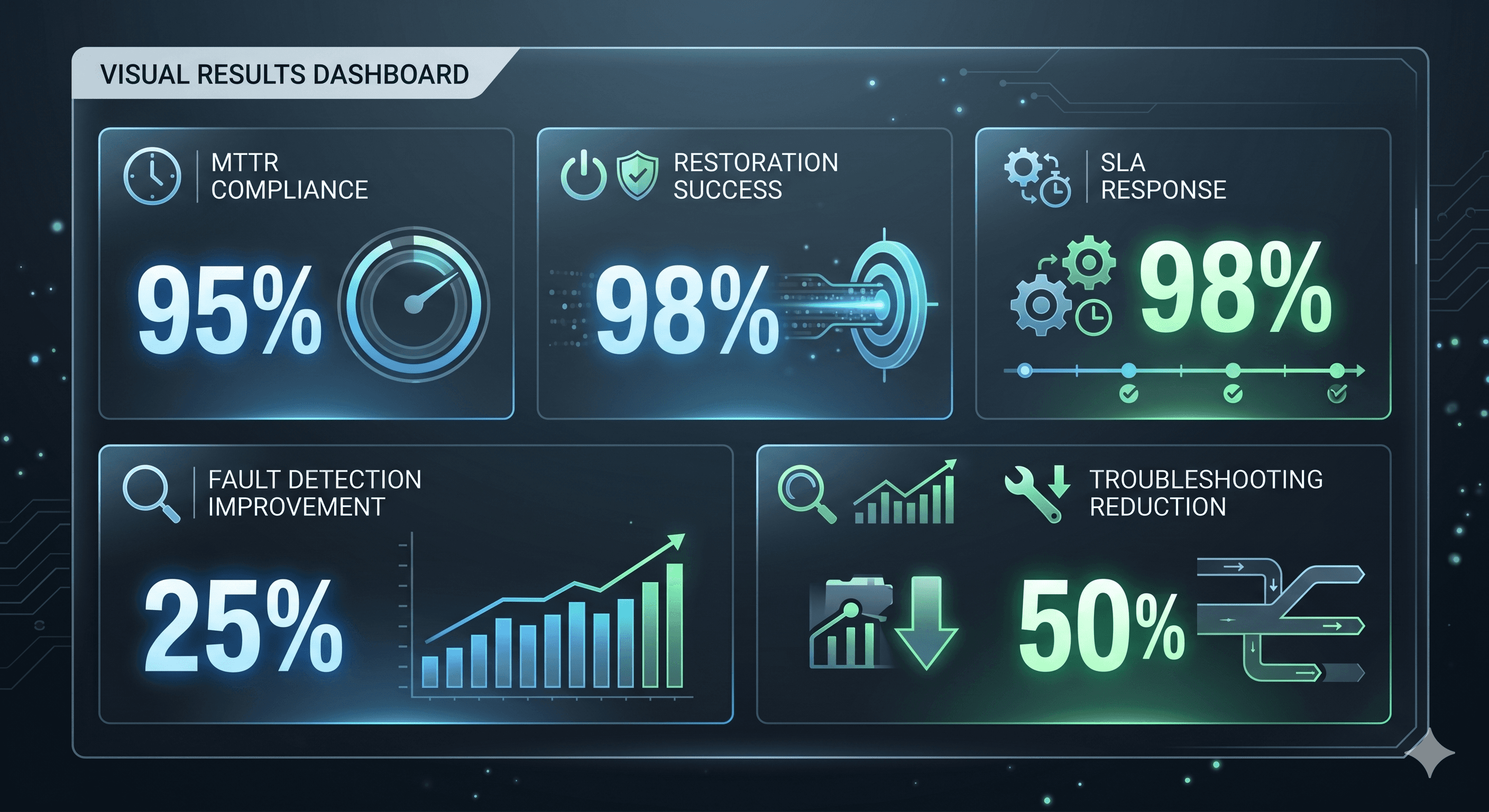
Maintained 95% compliance with MTTR targets across a high-volume national incident portfolio
Consistently achieved a 98% SLA compliance rate for network incident response activities
Maintained a 98% response rate supporting field engineering teams during restoration events
First-Time Restoration Success:
Achieved a 98% first-visit restoration success rate through accurate fault diagnosis and hardware requirement validation before dispatch
Operational Efficiency Improvements:
Reduced troubleshooting time for engineering teams by approximately 50% through the development of standardized procedures and restoration documentation
Improved fault identification efficiency by 25% through AI-assisted log analysis and alarm correlation techniques
Team Capability Enhancement:
Strengthened operational consistency through mentoring, knowledge sharing, and process standardization
Improved team effectiveness during major incidents by providing clear technical leadership and structured restoration methodologies
Key Expertise Demonstrated:
This experience strengthened my expertise across several critical domains:
Incident Command and Major Incident Management
DWDM Transport Networks
Carrier-Grade Routing and Switching
GPON, HFC, and Access Technologies
Network Operations and Service Restoration
Root Cause Analysis and Fault Isolation
Vendor and Stakeholder Management
Process Improvement and Operational Excellence
AI-Assisted Network Analytics
Technical Leadership and Team Mentoring
By combining structured operational practices with emerging AI-driven analytics, I consistently improved restoration performance, reduced operational risk, and maintained service reliability across some of Australia’s most critical telecommunications infrastructure.
Managing mission-critical telecommunications infrastructure requires more than technical expertise—it demands structured decision-making, effective stakeholder coordination, and the ability to perform under pressure when service availability is at risk.
This experience provided the opportunity to lead complex restoration activities across transport, access, and routing domains while continuously improving operational processes through standardization, automation, and AI-assisted analytics. By combining deep technical troubleshooting with a strong focus on operational excellence, I helped improve restoration outcomes, reduce diagnostic effort, and maintain high levels of service reliability across large-scale carrier networks.
The lessons learned from operating within a national Tier-1 telecommunications environment continue to influence my approach to engineering today: prioritize customer impact, drive data-informed decisions, automate repetitive tasks wherever possible, and build resilient systems that enable rapid recovery when failures occur.
As networks continue to evolve toward cloud-native, software-defined, and AI-assisted architectures, these foundational principles remain essential for delivering reliable services at scale.
