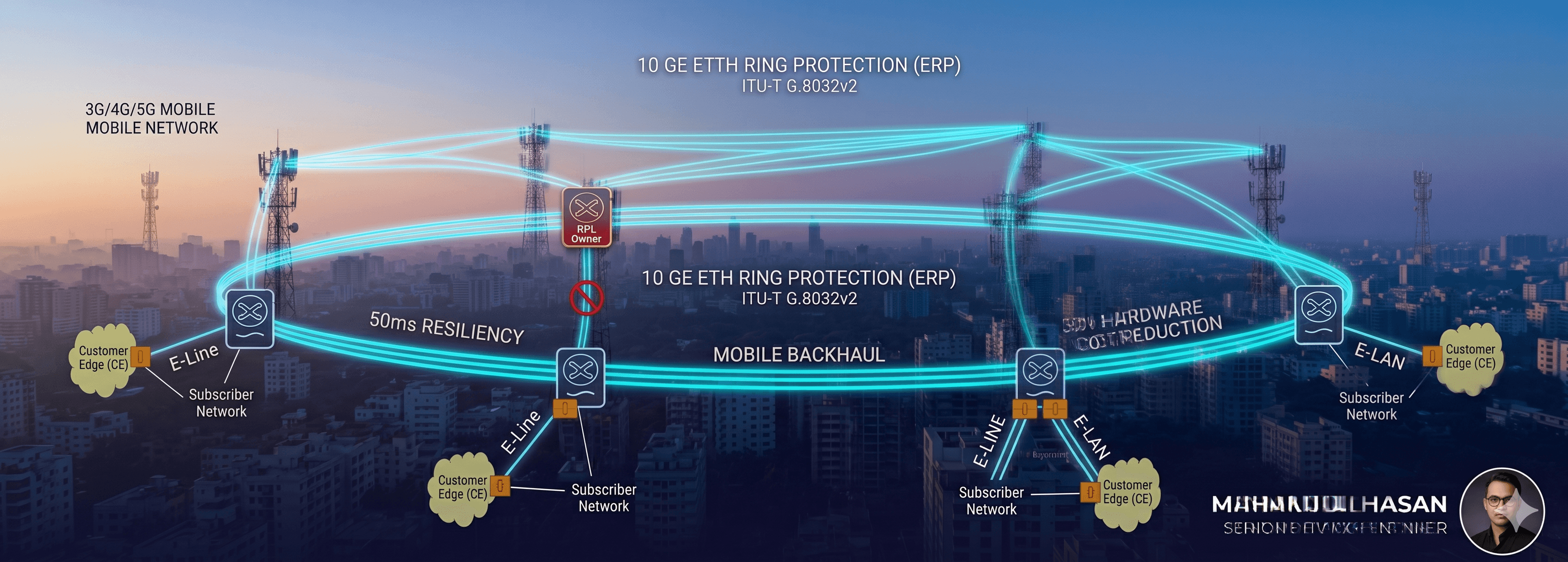
In an era where connectivity is the backbone of business, the transition from legacy transport systems to high-performance, AI-ready infrastructure is no longer a luxury—it is a competitive necessity. This case study details the end-to-end delivery of a carrier-grade mobile backhaul network, showcasing the practical application of ITU-T G.8032v2 Ethernet Ring Protection (ERP) and MEF-compliant Ethernet services. By prioritizing architectural resiliency and operational efficiency, I assisted a Tier-1 operator in modernizing their network capacity while simultaneously driving a 50% reduction in hardware expenditure.
As a Senior Network Engineer at Ericsson, I led the end-to-end delivery of a next-generation mobile backhaul solution for a Tier-1 mobile network operator. The customer required a rapid transition from a legacy SDH ring to a modern 10 GE Ethernet Ring Protection (ERP) architecture to support the bandwidth demands of new 3G/4G site launches. This was a mission-critical initiative, with a target of 150 metro area sites and a strict two-month execution timeline.
The legacy SDH transport network lacked the necessary capacity for 3G/4G bandwidth. The customer faced significant market pressure to launch services ahead of their primary competitor. Furthermore, integration faced a technical bottleneck: a persistent Continuity Check Message (CCM) failure between Maintenance End Points (MEPs), threatening project delivery.
I orchestrated the full project lifecycle, leveraging standardized protocols to ensure carrier-grade reliability:
Architectural Design: I implemented Ethernet Ring Protection Switching (ERPS) based on ITU-T G.8032v2. This design utilized a central Ring Protection Link (RPL) owner to block ports logically, ensuring a loop-free topology with sub-50ms protection switching performance.

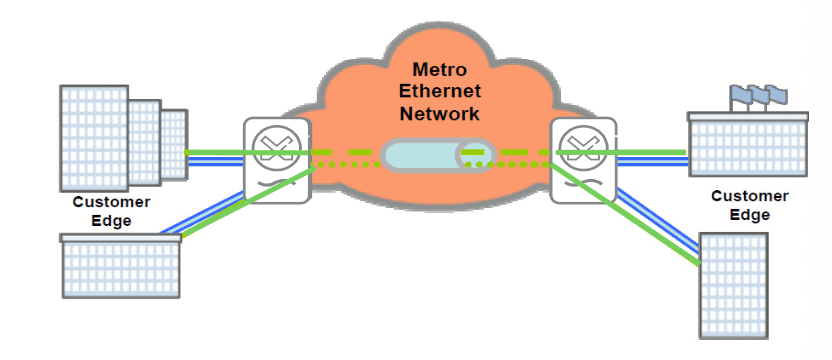
Ethernet Service Deployment: I designed and implemented MEF-compliant Ethernet services.
E-Line (EPL/EVPL): Deployed to provide point-to-point connections between cell sites and the core, utilizing statistical multiplexing for bandwidth efficiency.
E-LAN (EPLAN): Configured to provide multipoint-to-multipoint connectivity across the metro network.
Crisis Resolution: I initiated a "war room" with the 3rd-party DWDM vendor and customer stakeholders to troubleshoot the CCM failure. We identified that the DWDM client interface was set to "port transparent" mode; by reconfiguring this to "MAC transparent" mode, I successfully resolved the loop issue.
Proactive Knowledge Transfer: Recognizing the customer’s need for operational mastery, I designed the curriculum and conducted hands-on lab training sessions, enabling the customer to maintain the infrastructure locally.
Business Impact: Enabled the customer to launch 3G/4G services ahead of their competitor.
Operational Efficiency: Modernized the infrastructure, resulting in a 50% reduction in hardware costs compared to legacy SDH transport.
Project Delivery: Successfully met the project deadline one week ahead of schedule.
Customer Satisfaction: Received a 4 out of 5 rating from the customer for the design and delivery of the training program.
This project showcases my ability to bridge high-level solution architecture with hands-on technical execution. By successfully deploying G.8032v2 protection switching and MEF-compliant Ethernet services across a multi-vendor DWDM transport environment, I delivered a resilient, future-proof network that modernized the operator's infrastructure while significantly reducing OPEX.